When choosing acoustic panels, many buyers focus on appearance, thickness, or price. However, one of the most critical yet often overlooked factors is material density.
So, how does density affect acoustic panel performance?
The short answer: density directly determines how effectively an acoustic panel absorbs, controls, and manages sound.
In this article, we explain the role of density in acoustic panels, how it impacts real-world performance, and why high-density materials are essential for professional-grade wood slat acoustic panels.
What Does “Density” Mean in Acoustic Panels?
Density refers to the mass of material per unit volume, usually measured in kg/m³.
In acoustic panels, density affects:
How much sound energy the panel can absorb
Which frequencies are absorbed (high, mid, or low)
Structural stability and durability
Long-term acoustic consistency
Different materials—such as MDF, PET felt, mineral wool, and fiberglass—perform very differently depending on their density.
Why Density Is Critical for Sound Absorption
Sound waves lose energy when they pass through or strike materials that create internal friction.
Higher-density materials generally provide:
Greater resistance to sound wave movement
More friction within the material structure
Better absorption of mid-to-low frequencies
However, density must be optimized, not simply maximized.
Too low → sound passes through
Too high → sound reflects instead of being absorbed
Professional acoustic panels strike a balanced density range.
Low-Density vs High-Density Acoustic Panels
Low-Density Panels (Poor Performance)
Examples:
Thin foam panels
Low-density PET felt
Soft decorative panels
Limitations:
Absorb mainly high frequencies
Weak control of echo and reverb
Ineffective against voice and music clarity issues
Shorter lifespan and deformation over time
These panels may reduce flutter echo but do not deliver professional acoustic results.
High-Density Panels (Professional Performance)
Examples:
High-density MDF wood slat panels
Mineral wool-backed acoustic panels
Engineered composite systems
Advantages:
Balanced absorption across frequencies
Improved speech intelligibility
Better music clarity
Stronger structural stability
Consistent long-term performance
This is why high-density materials are widely used in commercial, architectural, and premium residential projects.
How Density Works in Wood Slat Acoustic Panels
Wood slat acoustic panels are not a single material—they are a system.
A typical high-quality wood slat acoustic panel includes:
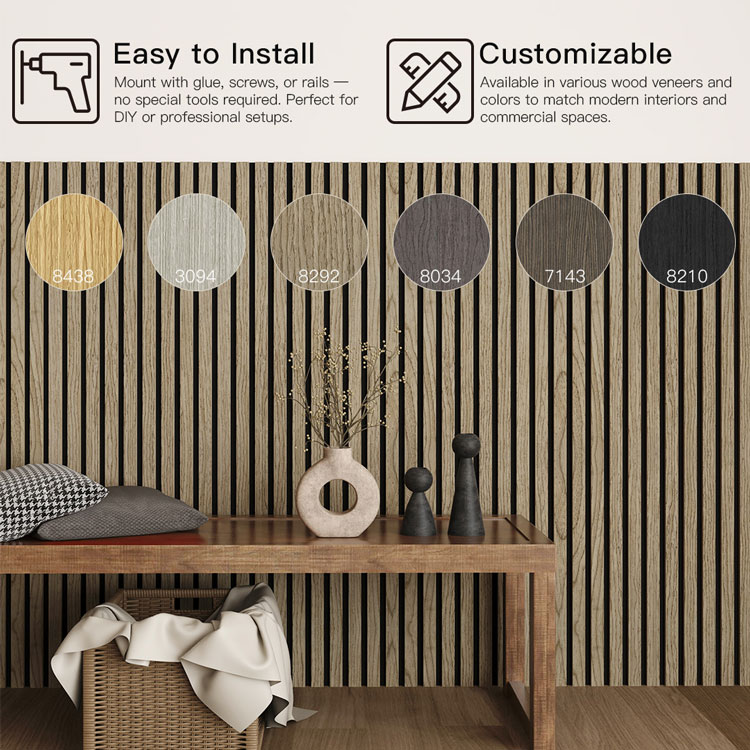
Natural wood veneer surface
High-density MDF slats
Acoustic backing (PET felt or mineral wool)
Each layer has a specific density function.
1. MDF Density and Acoustic Control
High-density MDF:
Provides structural rigidity
Helps diffuse reflected sound
Enhances mid-frequency control
Maintains precise slat spacing
Low-density MDF:
Warps more easily
Loses acoustic consistency
Reduces durability
Affects visual alignment
At Guangdong Leeyin Acoustics, we carefully select stable, high-density MDF to ensure consistent acoustic and structural performance.
2. Acoustic Backing Density Matters
The backing layer is responsible for absorbing sound energy.
Low-density backing → weak absorption
Optimized-density backing → strong absorption without reflection
Correct backing density improves:
Noise reduction
Echo control
Overall room comfort
This balance is essential for spaces like offices, studios, home theaters, and apartments.
Does Higher Density Always Mean Better Acoustic Performance?
Not always.
Extremely high-density solid materials (like concrete or solid wood) tend to reflect sound rather than absorb it.
Effective acoustic panels rely on:
Controlled density
Internal porosity
Layered construction
That’s why engineered acoustic panels outperform single-material solutions.
Density and Fire Safety, Sustainability, and Durability
Density also affects non-acoustic performance factors:
Fire Resistance
High-density MDF and treated acoustic backing improve fire ratings
Low-density foam often fails fire safety requirements
Environmental Performance
Proper density reduces material waste
High-quality MDF lowers emissions and improves lifespan
Certified raw materials meet international standards
Longevity
Dense panels resist sagging and deformation
Maintain acoustic performance over many years